


ISO 9001 Documentation Requirements for Certification Guide
ISO 9001 certification does not require a mountain of paperwork. It requires clear, controlled, useful documentation that proves your quality management system works.
For many organizations, documentation becomes a problem long before the certification audit. Procedures are copied from templates. Work instructions do not match actual practice. Records exist, but no one can find them quickly. These gaps create audit findings because they show weak control, not because the business failed to write enough pages.
A strong document system gives people the right information at the right time. It also gives auditors objective evidence that processes are planned, controlled, measured, and improved. This guide explains the key documents commonly used for ISO 9001 certification, including the Quality Manual, procedures, work instructions, and records. It also gives practical tips for creating and maintaining them effectively.
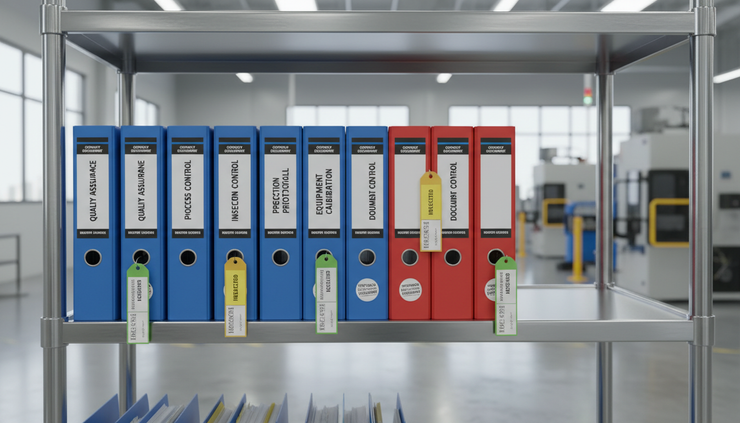
What ISO 9001 means by documented information
ISO 9001:2015 uses the term documented information. This includes both documents and records.
A document gives direction. It explains what must be done, who is responsible, or how a process works. Examples include procedures, policies, work instructions, process maps, and specifications.
A record gives evidence. It shows that an activity happened or that a requirement was met. Examples include inspection results, calibration records, training records, audit reports, and management review minutes.
This distinction matters during certification. An auditor will usually look for two things:
The organization has defined how important processes are controlled.
The organization has retained evidence that those controls are working.
ISO 9001 documentation should fit the size, risk, and complexity of the organization. A small service company may need fewer detailed instructions than a manufacturer with multiple shifts, regulated product requirements, and complex inspection activities. The standard allows flexibility, but it does not allow unclear control.
ISO 9001 documentation requirements commonly needed for certification
ISO 9001 does not give one fixed document list for every organization. Instead, it requires documented information where the standard says it is needed and where the organization needs it for effective process control.
The following document types are common in a certification-ready QMS.
Document type | Main purpose | How it supports the QMS |
Quality Manual | Describes the QMS structure and process approach | Helps people and auditors understand how the system fits together |
Quality Policy | States the organization’s quality direction | Gives a basis for quality objectives and improvement |
Quality Objectives | Defines measurable quality goals | Connects strategy to performance monitoring |
Procedures | Explains process requirements and responsibilities | Creates consistent control across departments or functions |
Work Instructions | Gives task-level steps | Reduces variation in critical or detailed activities |
Forms and templates | Standardizes data collection | Helps records stay complete and consistent |
Records | Provides evidence of conformity and performance | Supports audit trails, analysis, and decisions |
The right mix depends on your activities. The key test is simple: if the absence of a document could lead to inconsistent results, missed requirements, or weak evidence, the document likely adds value.
The Quality Manual explains how the system fits together
A Quality Manual is no longer a required document under ISO 9001:2015, but many organizations still use one because it is practical. It can serve as the top-level guide to the QMS.
A well-written manual does not repeat the full ISO 9001 standard. It explains how the organization has applied the standard to its own processes.
Typical content may include:
The scope of the QMS
Any ISO 9001 requirements that do not apply, with justification
A high-level process map or interaction of processes
References to key procedures and documented information
Roles and responsibilities related to quality
The approach to customer focus, risk, performance evaluation, and improvement
The manual helps new employees, process owners, internal auditors, and certification auditors understand the system quickly. It also reduces confusion when processes cross department boundaries.
For example, a manufacturer may use the manual to show how customer requirements flow from order review to purchasing, production, inspection, shipping, and corrective action. A service organization may use it to explain how customer requests are received, reviewed, delivered, checked, and improved.
The best ISO 9001 manual is concise. It should guide users to the right supporting documents rather than becoming a long document that no one reads.
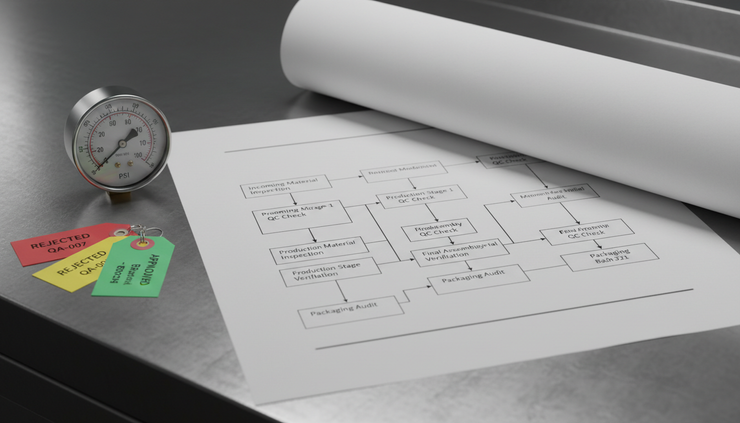
Procedures define how processes are controlled
Procedures explain how a process is managed. They usually sit below the Quality Manual and above work instructions.
A procedure should answer practical questions:
What is the purpose of the process?
Where does the process start and end?
Who is responsible?
What inputs are needed?
What steps or controls are required?
What records must be kept?
What happens when something goes wrong?
Common ISO 9001 procedures include document control, internal audit, control of nonconforming outputs, corrective action, purchasing control, training, production control, design and development, and customer complaint handling. Not every organization needs each one as a formal procedure. The need depends on risk, complexity, and how much consistency the process requires.
A procedure for document control, for example, should define how documents are approved, reviewed, updated, identified, distributed, and protected from unintended use. During an audit, the auditor may check whether obsolete documents are removed from use and whether current versions are available where work happens.
A procedure for internal audit should explain audit planning, auditor independence, audit criteria, reporting, follow-up, and retention of records. This gives confidence that audits are not random checks, but planned evaluations of the QMS.
Good procedures are written for the people who use them. They should reflect actual practice. If a procedure describes an ideal process that no one follows, it becomes audit risk.
Work instructions control detailed tasks
Work instructions give step-by-step direction for specific tasks. They are most useful when a task is complex, safety-sensitive, quality-critical, or performed by more than one person.
Procedures and work instructions should not duplicate each other. A procedure explains the process. A work instruction explains the task.
For example:
Procedure | Work instruction |
Control of monitoring and measuring equipment | How to verify a digital caliper before use |
Production control | How to set up Machine A for Part Number 245 |
Receiving inspection | How to inspect incoming fasteners |
Complaint handling | How to log and classify a customer complaint |
Work instructions may include photos, diagrams, acceptance criteria, tool settings, inspection points, or examples of acceptable and unacceptable output. In many operational settings, visual instructions work better than long written steps.
The goal is not to document every movement. The goal is to prevent errors where variation could affect quality. If experienced employees perform a simple low-risk task consistently, a detailed work instruction may not be needed. If a task affects product conformity, customer requirements, traceability, or inspection accuracy, written guidance is often necessary.
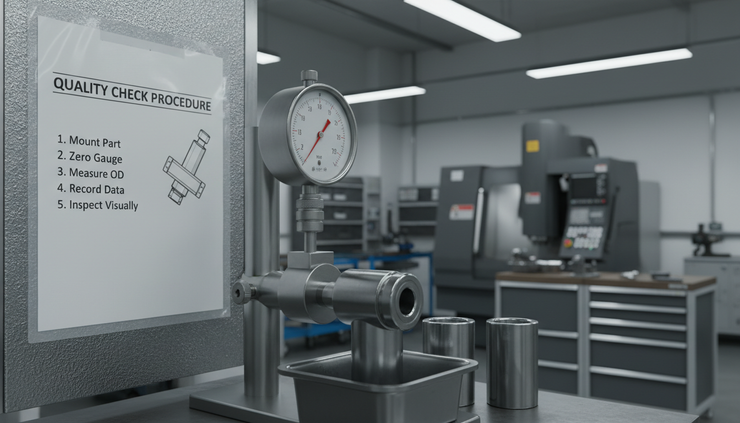
Records prove the system is working
Records are the evidence trail for certification. They show that planned activities were completed and that the organization checked results.
Examples of records commonly reviewed during an ISO 9001 certification audit include:
Customer order review records
Training and competence records
Calibration or verification records
Supplier evaluations
Inspection and test results
Production or service delivery records
Nonconformance reports
Corrective action records
Internal audit reports
Management review records
Quality objective performance data
Records should be legible, identifiable, retrievable, and protected. The organization should know how long each record is retained and how it is disposed of when no longer needed.
A common audit issue is not the absence of records, but poor control. Records may be incomplete, stored in different locations, missing approvals, or difficult to match to a product, order, batch, employee, or time period.
For certification, records must support traceability where traceability is required. If a product was inspected, the record should usually show what was inspected, when it was inspected, who performed the inspection, what criteria were used, and whether the result was accepted.
Document control keeps information reliable
Document control is one of the foundations of a credible QMS. Without it, employees may follow outdated instructions, auditors may question evidence, and process owners may lose confidence in the system.
An effective document control process should cover:
Approval before release
Documents should be reviewed and approved by authorized personnel before use.
Version identification
Users should be able to tell which version is current. This can be done through revision numbers, dates, electronic controls, or document status.
Access at point of use
People should have current information where they need it. This can be digital or physical, as long as access is controlled.
Change control
Updates should be reviewed before release. Changes should not create confusion or conflict with related documents.
Obsolete document control
Old versions should be removed, archived, or clearly marked to prevent unintended use.
External document control
Relevant external documents, such as customer specifications, regulatory requirements, drawings, or industry standards, should be identified and controlled when they affect the QMS.
Document control does not need to be complicated. A simple document register can work well if it is maintained. Electronic systems can help, but software will not fix weak ownership or poor review habits.
Tips for creating effective ISO 9001 documents
The best QMS documents are clear, accurate, and useful. They support the business rather than sit apart from it.
Start with the process, not the template. Talk to the people who do the work. Review current records. Observe how the process actually runs. Then document the controls needed to make the process consistent and auditable.
Keep the language simple. Use short sentences. Define only the terms that need defining. If a machine operator, inspector, buyer, or supervisor cannot understand the document, it needs revision.
Assign document owners. Every controlled document should have someone responsible for accuracy and review. The owner should understand the process, not just the formatting.
Use a consistent structure. Procedures are easier to maintain when they follow a common pattern, such as purpose, scope, responsibilities, process steps, records, and references.
Avoid copying generic procedures without tailoring them. Templates can help with structure, but they rarely match actual roles, systems, risks, and customer requirements without editing.
Link documents to records. If a procedure requires an inspection, identify the record that proves it happened. If a work instruction requires verification, show where the result is captured.
Review documents on a planned basis. Reviews do not always require changes. They confirm that the document still matches current practice, customer requirements, and process risks.
Train people when documents change. A revised procedure is not effective until affected personnel know what changed and how it affects their work.
Preparing documentation for the certification audit
Before the certification audit, conduct a focused document review. The goal is to find gaps before the auditor does.
Check that the QMS scope is clear. Confirm that quality objectives are measurable and monitored. Make sure required records exist for internal audits, management review, corrective actions, competence, operational controls, and monitoring activities.
Then compare written procedures to actual practice. This is where many findings appear. If employees perform the work differently from the procedure, decide whether the procedure needs revision or the process needs correction.
Internal audits should test both conformity and effectiveness. Do not only ask, “Do we have a procedure?” Ask, “Does this process achieve the intended result, and can we prove it?”

Comments